

What Stephen Covey taught me about prioritizing


I thought I was really good at prioritizing—until I read Stephen Covey’s perennial classic, The 7 Habits of Highly Effective People . As part of his Habit 3, “Put First Things First,” Covey lays out his Time Management Matrix along two dimensions, Urgency and Importance. The more urgent, the more time critical. The more important, the more results-oriented and high priority.
Here is a graphic depiction:
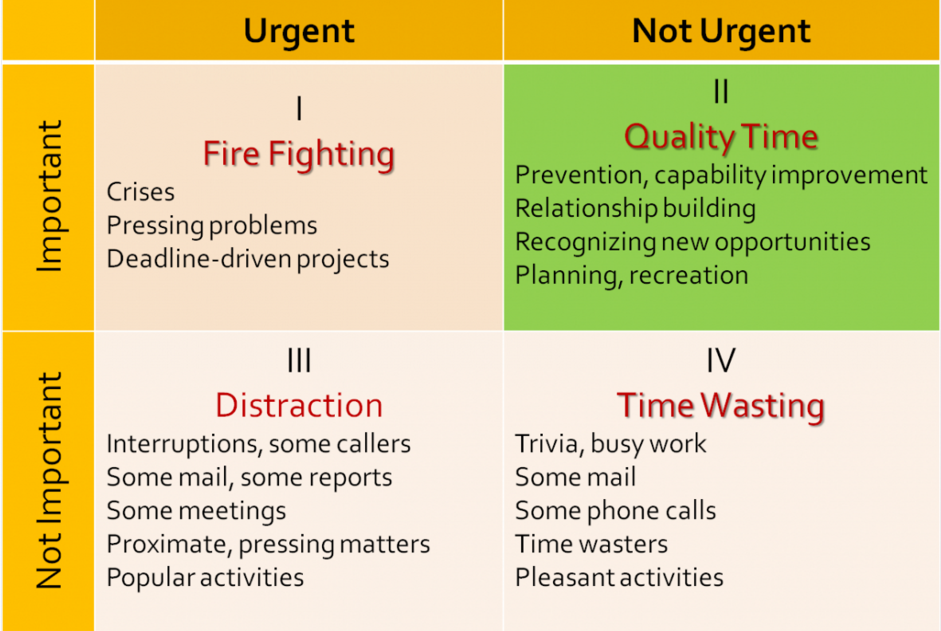
As you can see, people who spend the majority of their time in Quadrant I (urgent and important) are reacting to one crisis after another, leading to stress and burnout. People who spend their time mostly in Quadrant III (urgent and not important) are stuck responding to external demands, while those who spend their time in Quadrant IV (not urgent and not important) are distracted or wasting their time.
Covey advocates spending the majority of our time in Quadrant II (not urgent and important), as the foundation of a productive and fulfilling life. He writes:
“Quadrant II is the heart of effective personal management. It deals with things like building relationships, writing a personal mission statement, long-range planning, exercising, preventive maintenance, preparation—all those things we know we need to do, but somehow seldom get around to doing, because they aren’t urgent. To paraphrase Peter Drucker, effective people are not problem-minded; they’re opportunity-minded. They feed opportunities and starve problems. They think preventively. They have genuine Quadrant I crises and emergencies that require their immediate attention, but the number is comparatively small.”
Covey explains that the more we spend our time and energy on Quadrant II, preventative and future-focused activities, the more we’ll shrink the fire drills and distractions that characterize the other, less effective, Quadrants.
This Time Management Matrix has made it abundantly clear to me that I really don’t prioritize much at all. I thought I did because I work long hours and I work hard, so I do get a lot done. I am addicted to checking things off the daily to-do lists I keep in my paper calendar. But everything is a priority to me, whether returning a not-so-critical phone call, promoting my own books, editing my blogging interviews, developing my coaching practice, applying to give my workshop at Chicago locations, reading psychology and self-help books, checking my social media stats, researching an interesting concept for Coach’s Corner, you name it. I am busy, busy, busy.
Worse, I’m often multi-tasking—listening to a podcast while I cruise Facebook and Twitter, for example—which really means I’m not getting much out of either experience. And the proactive, forward-thinking activities of Quadrant II, like exercising, strategic planning, and relationship building, often take a back seat.
Evidently, I have work to do on setting priorities, which will translate into long-term plans that feed into proactive daily activities. Covey gives extensive instruction on how to do this, so that will be a good place to start. But one thing’s for sure, I’m not giving up all of my Quadrant IV time wasters, like binge watching Orange Is the New Black!
How do YOU spend your time? How well do YOU prioritize? What’s one step YOU could take toward more Quadrant II activities?
Don’t miss any inspiring stories of reinvention! Subscribe.
About Post Author


Really great explanation of Covey’s Time Management Matrix (which I recently learned is also called the Eisenhower boxes.) Most people have difficulty finding time for Quadrant II activities and yet, studies show that these are the things we need for overall contentment. Your post is another, much needed, reminder that we must find time for Quadrant II. So I’m off to read a good book, then exercise, and make a healthy dinner!
What a perfect plan for the evening! Thanks for reading Sharon.
Thanks for a great article. It is nice to be reminded about Stephen Covey’s sage advice. I remember reading his book in the ’80’s and again in the 90’s. I might pull it out again. These tips are timeless. Covey’s strategies for living, engaging, and working effectively are so true.
I think this is actually the first time I’ve read the book cover to cover. And you’re right, it’s so timeless and holds such great insight and advice. Thanks for commenting!
This was so interesting and it helped answer a question I have wondered about. I believe I function in Quadrant II. I am organized, have 5 jobs, always have time to do what I want to do, have quality time with family and friends, do not feel time pressured or rushed, always ready to take on something new (started my last career at 67) and am always on time.
This helps me to understand why people feel so pressured and stressed. Thank you.
Wow Carol, you are the model we should all be emulating! You’ve figured out how to manage so much. Now I need to get started on the same!! Thanks for reading.
I haven’t red this book in many years, but it left an impact on me when I did read it. It is so easy to get distracted by what seems important and urgent but really isn’t- like when the phone rings and you answer it and it is a telemarketer! Covey wrote this before the advent of social media- I can image that much of the pressing social media time warp is quadrant 4 as well!
I know right?? He was ahead of his time and the advice still holds. So easy to get distracted when I see emails or Tweet notifications pop up!
That’s a mold-breaker. Great thinking!
Greetings,I wanted to re:connect with you after our initial meeting during the Energy Block party event in Cypress Hill Brooklyn. We had the both with live art for kids. Please contact me as soon as you can so that we discuss partnering during the summer. We can be reached at 718.676.6006.Catherine ….ARTS East New York Inc.
This is such a compellingly clear guidepost for where we need to focus our attention and energy to be both productive and fulfilled. When you (and Covey) explain it this way, it really makes it seem doable. Not necessary easy (with all the distractions of social media and just, well, life)-but doable. Thanks!
I agree Roxanne. It really gave clarity to what I’m doing right and what I need to improve when prioritizing my to dos, always a challenge for me! Thanks for reading.